Already have S2P, ERP or supplier-risk tools?
Keep them. Choose a task your team still needs to complete. Pala prepares the analysis, sourcing materials and follow-up for you to review.
For procurement leaders who need more capacity, additional expertise, or both. Pala analyses spending and contracts, prepares sourcing and negotiation work, and follows approved actions through to measured results.
What Pala prepares
Renew, renegotiate or replace?
You approve the next step before contacting the supplier or signing an agreement.
Pala can start with the records you already have. No existing procurement platform is required.
Keep them. Choose a task your team still needs to complete. Pala prepares the analysis, sourcing materials and follow-up for you to review.
Start there. Use spending, contracts and supplier records to identify priorities and prepare the first initiative. No procurement platform is required.
Start with read-only files or exports. Ongoing connections depend on your environment and are agreed separately.
See how ProcureLabs fitsFollow one fictional packaging initiative. Each stage retains the source, the work prepared and the decision your team owns.
Fictional worked example. No customer data or live execution. USD amounts; comparable specification.
SRC-01 / source review
From 1,200 incoming rows, accept 1,180, withhold 12 duplicates and quarantine 8 incomplete rows. Check the existing client initiative register before creating work.
The initiative and its sourcing event retain their own statuses. An award is a commercial decision, not a verified realised outcome.
Read the connected example and its calculationsEight interconnected capability modules. Each one is useful in isolation; together, they give you a complete picture of procurement performance.
Cleanse, classify, and cube your spend data across supplier, category, cost centre, and time. Go beyond dashboards — surface the exceptions and anomalies that need attention.
Monitor supplier financial health, ESG exposure, geopolitical risk, and news signals in real time. Know about supplier distress before it becomes a supply chain event.
Extract obligations, pricing, rebates, and renewal terms from contracts automatically. Compare actuals against committed terms and flag drift before it becomes a write-off.
Run 29 exception categories — price overcharges, duplicate invoices, maverick spend, unclaimed rebates — continuously against every transaction. Recover value instead of writing it off.
Benchmark your pricing against market rates. Track commodity indices relevant to your category portfolio. Know when to lock in and when to renegotiate.
Ask procurement questions in plain language and get grounded, data-backed answers. Pala draws on your contracts, spend, and supplier data — not generic training data.
Track initiatives from identification through to verified savings. Connect pipeline to realised value with an audit trail that holds up to finance scrutiny.
Monitor supplier compliance, contract adherence, and procurement policy conformance in one place. Automate the evidence gathering that used to consume analyst time.
Also see: spend leakage detection, contract intelligence, supplier risk monitoring.
Start with agreed records and a defined task. Scope any ongoing connection separately.
Ingest spend transactions, supplier master data, contracts, and ERP feeds via direct integration or structured upload. Agree scope, permissions and setup requirements before beginning.
Our AI assistant Pala classifies spend to a standardised taxonomy, extracts contract terms, and enriches supplier records with external risk signals — automatically.
Spend exceptions, supplier alerts, contract drift flags, and savings opportunities are surfaced to the right people in real time — not locked in monthly reports.
Procurement, finance, and category teams work from a shared view of priorities, with Pala drafting correspondence, generating reports, and tracking delivery against targets.
Results from procurement teams using ProcureLabs.
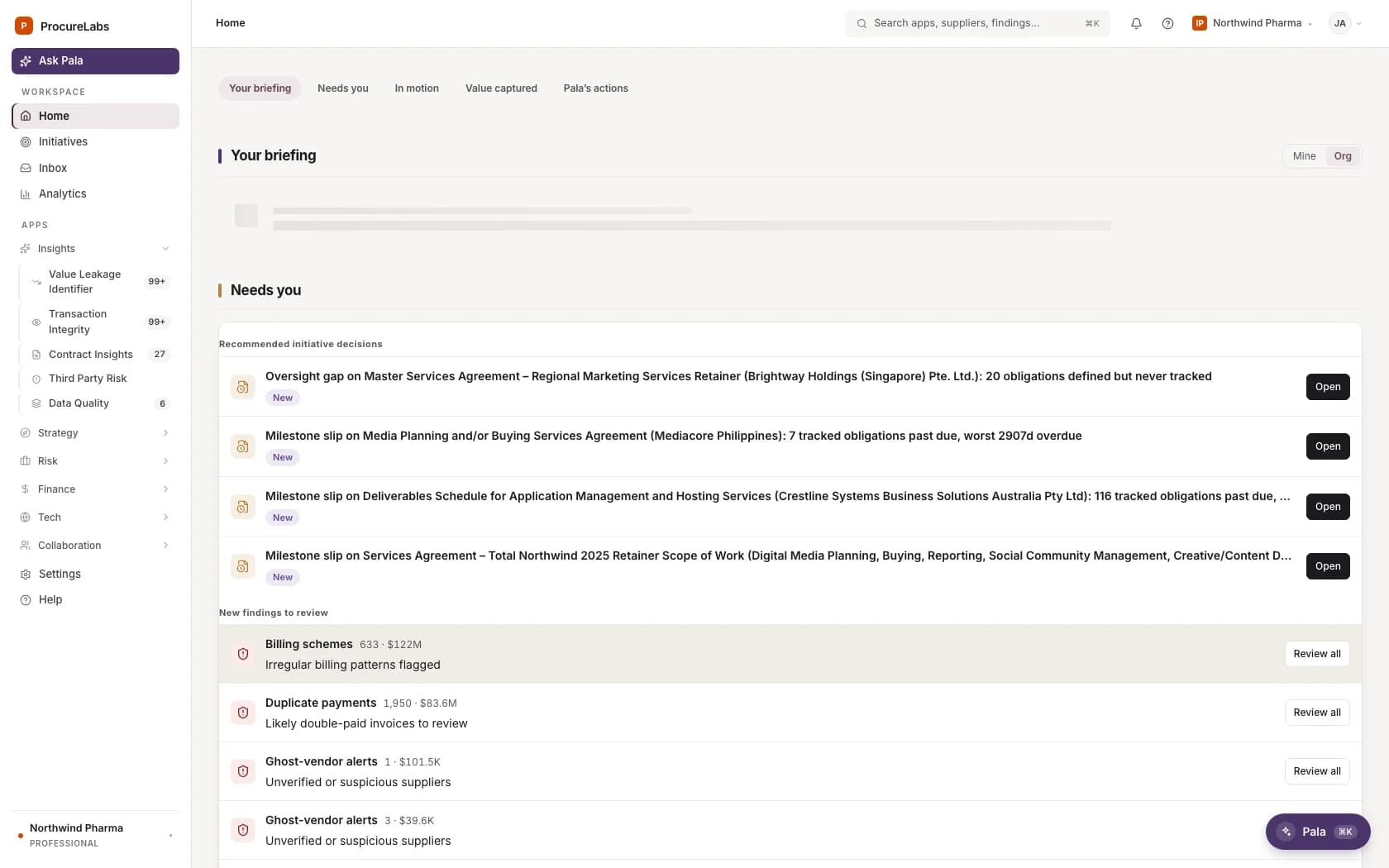
ProcureLabs adapts to what each stakeholder needs to see and act on.
Procurement intelligence software connects spend data, supplier information, contracts, and market signals into an integrated platform. It surfaces insights that help procurement teams make better decisions — on sourcing, supplier risk, contract compliance, and savings delivery — rather than just providing data exports or static reports.
Spend analytics tools classify and visualise historical spend. Procurement intelligence software goes further: it monitors for exceptions in real time, tracks supplier risk, analyses contract terms against actuals, benchmarks pricing against market rates, and delivers AI-generated recommendations — not just data views.
No. Keep the systems you have, or start with files. Agree one useful piece of procurement work, the records it needs and any ongoing connection separately.
Start with agreed copies of spend, supplier, contract and related records. Confirm the required interface and availability separately if ongoing work needs a system connection.
Pala is ProcureLabs's AI procurement assistant. It is grounded in your organisation's actual spend, supplier, and contract data — not generic training data. You can ask procurement questions in plain language ("Why did IT spend increase this quarter?", "Which suppliers pose the highest delivery risk?") and receive data-backed answers with source citations.
Agree the scope, usable records and permissions before the review. Timing depends on the work and data quality; any ongoing connection is scoped separately.
Connect your ERP in minutes. Pala surfaces your first spend exceptions, supplier alerts, and contract findings the same day. No implementation project required.
Also explore: spend leakage detection · contract intelligence · supplier risk monitoring